Primal Grow Pro › Blog › Two Names For One Job
Two Names For One Job: Ginkgo And Vinpocetine On The Circulation Line
Circulation is one of the four supports the seller names for Primal Grow Pro, and the seller does not say which ingredient is meant to carry it. Two names on the list, ginkgo biloba and vinpocetine, have long research histories written in the language of blood vessels and blood flow, and they share one capsule. It is tempting to picture them as two workers on the same job, with the capsule pushing twice as hard in the same direction. This article checks that picture against the published pharmacology, the human bleeding reviews, and the small amount of work that has ever named the two together.
- The two ingredients do not act through the same switch. Ginkgo’s best-documented vascular action is antagonism of platelet-activating factor, mainly through the ginkgolide constituents. Vinpocetine’s best-documented action is inhibition of a calcium-dependent phosphodiesterase, first shown in vessel wall tissue.
- In a six-person crossover of a ginkgolide mixture, platelet aggregation caused by platelet-activating factor was blocked, and in the dish aggregation caused by ADP was not. The action is specific to one pathway, not a general thinning of the blood.
- A meta-analysis of 18 randomised trials of standardised ginkgo extract found no significant effect on ADP-induced platelet aggregation, clotting times or fibrinogen, and a small fall in blood viscosity. A 50-man crossover trial found no sign of inhibited coagulation in 29 measures.
- In a laboratory comparison that included human platelets, vinpocetine relaxed vessel tissue and had no effect on platelets. The common assumption that it thins the blood rests on thinner ground than it sounds.
- The one controlled trial found that names a ginkgo and vinpocetine compound measured reaction times in 24 healthy adults. No study found measured platelets, clotting or blood flow for the two together, so whether their effects add up is an open question rather than a known one.
- The label prints no amount for either ingredient, so any sum of their effects would have to be guessed. Trial doses appear below only as descriptions of what the trials gave.
What “pushing in the same direction” would have to mean
Two ingredients can be said to push the same way at four different levels, and each level has its own evidence and its own consequence. They could act on the same molecular target. They could both change how blood platelets behave. They could both widen or relax vessels and so change flow. Or they could both change what actually matters to a person on a blood-thinning prescription, which is whether they bleed more easily than they otherwise would.
Marketing copy tends to collapse those four into one, and it is the reason two names under one heading look like a matched pair. The interesting thing about ginkgo and vinpocetine is how differently they come apart when each level is checked in turn.
Two housekeeping points before the evidence. First, the seller’s page lists four supports (everyday male vitality, circulation, energy and mental sharpness) without tying any of them to a single ingredient. The site’s How It Works page leans on ginkgo and on carnitine for the circulation route. This article picks up ginkgo and vinpocetine for a different reason: both have decades of published work framed around vessels and blood flow, and both sit in the same capsule, so a reader who takes the label at its word will eventually ask what the two do together.
Second, the label prints no amount for either one. That matters for everything below. An interaction question is a dose question, and with no dose there is no way to add the two effects up. The doses that appear in this article are trial doses, described as such, and none of them is a statement about what a Primal Grow Pro capsule holds. For the arithmetic of what a single capsule can physically carry, see the capsule-capacity article.
Ginkgo’s vascular pharmacology: one receptor, not a blanket
The most quoted pharmacological fact about ginkgo is that one of its constituents, ginkgolide B, blocks the receptor for platelet-activating factor, usually shortened to PAF. A review of ginkgolide B in the Chinese Medical Journal describes it as the most potent antagonist of PAF, with its therapeutic actions in a range of conditions running mainly through the PAF receptor. PAF is a signalling lipid that platelets, white cells and vessel walls respond to, and it is involved in aggregation, in inflammation and in changes to vessel permeability.
This is not only a test-tube story. A 1987 Lancet study gave six normal volunteers a ginkgolide mixture called BN 52063 in a double-blind, placebo-controlled crossover design. Two hours after 80 mg or 120 mg by mouth, the skin weal and flare that follow an injection of 400 ng of PAF were inhibited in a dose-related way. After 120 mg the flare area fell by a mean of 62.4% and the weal volume by 60%. Both doses significantly inhibited PAF-induced platelet aggregation in platelet-rich plasma, and in the dish the mixture inhibited PAF-induced aggregation but not ADP-induced aggregation.
Read that last clause slowly, because it carries most of the meaning of this section. Platelets can be pushed to clump by several different triggers. The ginkgolide mixture blocked one of them and left another alone. That is what a receptor antagonist looks like. It is nothing like a general anticoagulant, and the difference explains a good deal of what the bleeding literature shows later.
Some limits deserve saying plainly. The study had six participants. It used a purified ginkgolide mixture, not a leaf extract, so it shows what the constituent can do rather than what a ginkgo capsule does. It measured responses to a deliberately injected dose of PAF, which is an experiment about a pathway. It did not measure bleeding, and it did not measure blood flow in any organ. It is a clean demonstration that the mechanism exists in people, and it is nothing more than that.
What ginkgo does in ordinary clotting and bleeding tests
The obvious next question is whether a mechanism that blocks PAF-driven aggregation shows up in the standard tests of how well blood clots, and whether people bleed more when they take the extract. Several bodies of work address this, and they do not all say the same thing, so it is worth setting them out together.
| Source | What it was | Amount (as the study gave it) | What it found |
|---|---|---|---|
| Köhler and colleagues, 2004 | Randomised, placebo-controlled, double-blind crossover in 50 healthy male volunteers, 7 days per arm | EGb 761, 2 × 120 mg a day | Among 29 coagulation and bleeding measures, none showed inhibition of coagulation or platelet aggregation. A slight rise in gastrointestinal complaints. The first author’s affiliation is the extract’s manufacturer. |
| Kellermann and Kloft, 2011 | Meta-analysis of 18 randomised trials, 1,985 adults (87% patients, 13% healthy) | Standardised extract; high-dose subgroup was 240 mg a day or more | Lower blood viscosity. No significant effect on ADP-induced platelet aggregation, fibrinogen, aPTT or prothrombin time. A small aPTT shortening in the high-dose subgroup that the authors judged not clinically relevant. |
| Bent and colleagues, 2005 | Case report plus systematic review of published case reports | Not applicable | Fifteen published reports of bleeding with ginkgo, eight of them intracranial. Thirteen named other bleeding risk factors. Only six clearly described stopping ginkgo and no recurrence. |
| Bone, 2008 | Review of controlled studies and case reports | Mostly EGb 761 | Controlled studies consistently show no significant effect on haemostasis and no adverse effect on co-administered aspirin or warfarin. Case-report quality is described as low, and an idiosyncratic event is not ruled out. |
| Mai and colleagues, 2025 | Retrospective observational study of hospital prescriptions of ginkgo extract, 2022 to 2023 | As prescribed | Of 2,647 prescriptions, 342 carried a drug interaction, most often with clopidogrel and aspirin. Interaction was associated with bleeding and abnormal coagulation tests. Anticoagulant interactions were not statistically significant. |
Five sources, five designs. The controlled trials are reassuring about ordinary coagulation, and the case-report and hospital-record work keeps the question about people on antiplatelet drugs open.
Put together, the picture is coherent once you keep the mechanism in mind. The controlled trials measured the things a standard coagulation panel measures, and a PAF-specific action would not necessarily move those. The meta-analysis is worth a second look for what did move: a reduction in blood viscosity of about a millipascal-second, which is a blood-flow-adjacent finding and, taken at face value, is the most circulation-flavoured number in the whole ginkgo bleeding literature. It is a laboratory measure, though, and the meta-analysis was built to ask about bleeding, not about whether anyone’s circulation felt any different.
The case-report literature is where caution survives. Bent and colleagues did not say ginkgo causes bleeding. They said a structured reading of the reports suggests a possible causal association and that patients with known bleeding risks should be counselled. The hospital record study from 2025 is a similar kind of evidence: it found a statistical association between ginkgo-drug interactions and bleeding, but it is retrospective and observational, it involved patients who were ill enough to be in hospital, and the paper itself lists several other drugs, among them clopidogrel, aspirin and celecoxib, as associated with bleeding. It is a signal to keep an eye on, not proof of a mechanism.
For the milligram story behind the ginkgo figures, and for the six-year prevention trial that came back flat, see the ginkgo 240 mg article. This article is about what happens when ginkgo has company.
Vinpocetine’s pharmacology: an enzyme and a vessel wall
Vinpocetine is a semi-synthetic compound derived from an alkaloid of the periwinkle plant, a fact the vinpocetine article covers from the regulatory side. Its pharmacology is different in kind from ginkgo’s.
The early vascular work was done on tissue. In a 1984 study in rabbit aorta, vinpocetine selectively inhibited a calcium-dependent phosphodiesterase, with half of the enzyme activity blocked at about 21 micromolar. In aortic strips it raised cyclic GMP and had no significant effect on cyclic AMP. The authors proposed that vinpocetine may relax vessels by increasing cyclic GMP in the smooth muscle. The enzyme is now usually called phosphodiesterase type 1, and a 2026 review in Biomolecules lists PDE1 inhibition first among vinpocetine’s mechanisms, alongside sodium channel blockade, reduced oxidative stress and suppression of neuroinflammation. The disclosure statement says both authors are employees of a pharmaceutical company, Gedeon Richter, which is worth knowing when reading a review that calls the compound’s effects “additive or synergistic”.
The picture has grown more complicated. A 2010 paper in PNAS found that vinpocetine inhibits inflammatory signalling through NF-kappaB by directly targeting IKK, and that this effect did not depend on its phosphodiesterase action. That was shown in cells and in a mouse model of lung inflammation, not in men taking a capsule, and three of the authors declared a start-up company hoping to license the work. It illustrates that an ingredient sold under a single mechanism label often has several actions in the laboratory and that the label is a simplification.
The platelet question, checked directly
Because vinpocetine is widely described as improving blood flow, a natural assumption is that it also discourages platelets from clumping. The direct check is less supportive than the assumption. A 1990 paper from Lund compared several isozyme-selective phosphodiesterase inhibitors on rat aorta and on human platelets. Two inhibitors of a cGMP-inhibited enzyme relaxed the aorta and inhibited ADP-induced platelet aggregation. Vinpocetine, the inhibitor of the calcium-calmodulin-dependent enzyme in the set, relaxed the vessel tissue without changing cyclic AMP levels and had no effect on platelets.
That is one paper, in one set of conditions, and it is from 1990, so it does not close the matter. What it does is undo an easy inference. Vinpocetine’s vascular action, as described in the tissue work, runs through a different enzyme and a different cyclic nucleotide from the one that controls platelet cAMP, and in the one experiment I found that put it beside human platelets it left them alone.
Vinpocetine and blood flow in people
The human blood-flow evidence for vinpocetine is narrower than the tissue work and it comes from a very different setting from a daily capsule. A 2002 double-blind trial randomised 43 patients with ischaemic stroke to a single intravenous infusion, 20 mg of vinpocetine in 500 ml of saline or saline alone, and watched the affected side of the brain with near-infrared spectroscopy and transcranial Doppler. Total and oxygenated haemoglobin rose more with vinpocetine but the differences did not reach significance, deoxygenated haemoglobin rose significantly, and a Doppler spectral intensity measure rose significantly more with vinpocetine than with placebo. Mean flow velocity and the pulsatility index did not differ. The authors concluded that vinpocetine increases cerebral perfusion and oxygen extraction; the first author’s affiliation is the pharmaceutical company Gedeon Richter.
Read for what it is, that is a positive but mixed result, from a single intravenous dose, in people with a stroke, using measurements chosen to detect it. It does not describe the effect of a swallowed capsule on the blood flow of a healthy man, and it cannot be moved across without a leap.
The wider clinical record is not much stronger. The Cochrane review of vinpocetine for cognitive impairment and dementia found three trials in 583 people, all from before the 1990s, reporting benefit at 30 mg and 60 mg a day, but with few people treated for six months or more, and it concluded that the evidence was inconclusive and did not support clinical use. It also noted few adverse effects at the doses used, though adverse events were inconsistently reported.
A single 20 mg intravenous infusion in stroke patients and 30 to 60 mg a day by mouth in dementia trials are the two figures most likely to be quoted about vinpocetine. Neither describes the amount in a Primal Grow Pro capsule, which the label does not print. They are here to show what the research was, not what the bottle contains.
Side by side, without the marketing sentence in between
| Question | Ginkgo (leaf extract and its ginkgolides) | Vinpocetine |
|---|---|---|
| Best-documented mechanism | Antagonism of the platelet-activating-factor receptor, mainly by ginkgolide B | Inhibition of calcium-dependent phosphodiesterase (PDE1), raising cyclic GMP in vessel muscle |
| Human platelet finding | PAF-induced aggregation blocked by a ginkgolide mixture; ADP-induced not | No effect on human platelets in the one direct laboratory comparison found |
| Ordinary clotting tests | No significant effect in 18 pooled randomised trials; no inhibition in a 50-man crossover | No controlled trial of clotting tests found in these searches |
| Blood-flow-type finding | Lower blood viscosity in the pooled trials | Higher cerebral perfusion measures after one intravenous dose in stroke patients |
| Amounts in the studies above | 80 to 120 mg of a ginkgolide mixture once; 240 mg a day of extract in trials | 20 mg intravenously once; 30 to 60 mg a day by mouth in dementia trials |
| Who was studied | Healthy volunteers, patients with dementia, artery disease or diabetes | Stroke patients, people with dementia |
The two columns share a topic, blood and vessels, and very little else. “Same job” is a heading on a label, not a finding in a paper.
That table is the heart of the article. If you asked a pharmacologist whether two compounds with these profiles would obviously stack, the reasonable answer would be that they might overlap in outcome, since both could favour flow through the microvasculature, while starting from different places. Nothing in the evidence tells you the sum is greater than the parts, and nothing tells you it is not. It tells you the two do not share an obvious lock and key.
What has been tested with both in one product
Here the honest answer is short. I found one controlled trial and one case report that name the combination.
Polich and Gloria, 2001, is the trial. Twenty-four normal adults took either placebo or capsules of a nutrient compound containing ginkgo biloba, which the title identifies as a ginkgo and vinpocetine compound, for 14 days each in a double-blind crossover, then completed ten computerised perceptual, attention and short-term memory tasks. A working-memory-capacity task showed a reliable response time decrease of about 50 milliseconds on the active product. The study was about thinking speed. It did not measure platelets, clotting, bleeding or blood flow, its abstract gives no dose, and 24 people cannot rule out an uncommon reaction.
The case report is a 2017 dermatology paper describing a man who repeatedly developed itching and redness on the shaft of the penis after taking a natural product containing ginkgo biloba and vinpocetine, and concluding that both should be added to the list of agents that can cause a fixed drug eruption. One person, one product, one skin reaction. Such reports exist for nearly every ingredient sold at scale and they mostly show that reporting is possible.
Beyond those two, the searches I ran turned up no study that looked at ginkgo and vinpocetine together on platelet function, coagulation, bleeding or blood flow. That is a statement about my searches and about the indexed literature, not a proof that no one has ever looked. It is still worth saying out loud, because the way a two-ingredient label is usually read implies a body of evidence that is not there.
What an untested combination does and does not tell you
An untested combination is not a dangerous one, and it is not a synergistic one. It is an unmeasured one. The evidence for each ingredient by itself is real and, on the bleeding question, fairly reassuring for ginkgo in people who are not on antiplatelet drugs. But every number above was learned with one of the two ingredients in the body at a time, at a stated dose, in a defined population. A capsule that names both and prints no amounts for either has left out the one piece of information that would let a reader apply that evidence.
The practical part: three questions worth taking to a pharmacist
Nothing here says a healthy man who takes no medicines should expect trouble from the two names sharing a capsule. It is a reason for some people to check before they order.
- Do you take an anticoagulant or an antiplatelet drug? Warfarin, apixaban, rivaroxaban, clopidogrel, aspirin taken for the heart and similar medicines are the ones in play. The controlled ginkgo trials are reassuring, and the case reports and hospital records are the reason the question is still asked. The pharmacist who dispenses the prescription is the right person to ask, and the medication-list article sets out what to bring.
- Is a procedure coming up? Anything involving a cut, a needle in a joint or a dental extraction is a reason to mention every supplement, including ones you consider mild, to whoever is doing it. It costs a sentence.
- Do you bruise or bleed more than you used to? That is worth a conversation regardless of any supplement, and it is a reasonable thing to raise before adding one.
This is also where St. John’s wort belongs in the conversation, since it is a different kind of problem on the same label: it acts on how the liver handles other medicines. It has its own article, St. John’s Wort And Your Prescription.
Read the label first, then decide about Primal Grow Pro
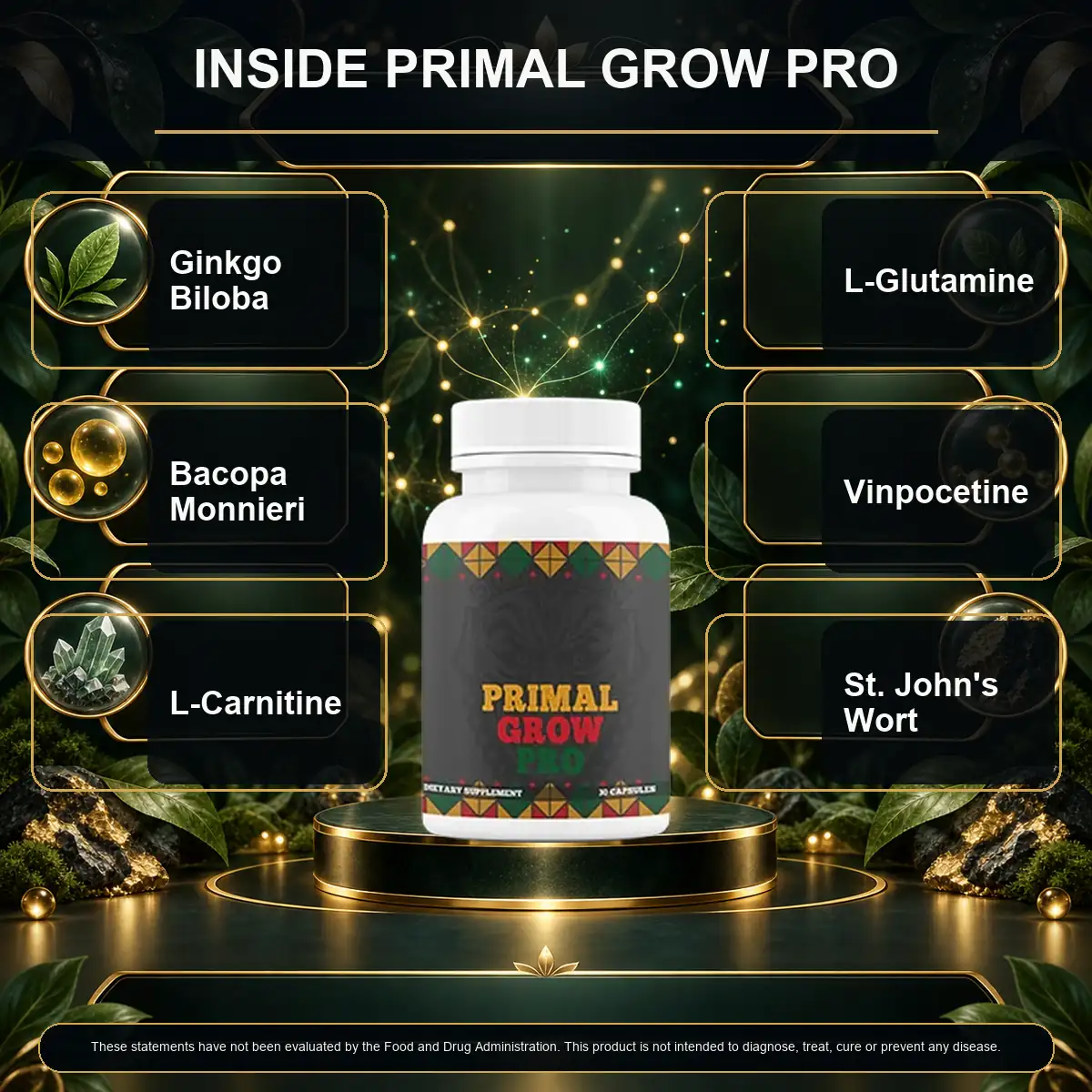
Seven ingredients are named, no amounts are printed, and ginkgo and vinpocetine are two of them. Check the medicine question before the order question.
Order Primal Grow ProHow to read a two-ingredient circulation line on any label
- Ask which mechanism each name is meant to bring. If both are described only as “circulation support”, the label has told you a category, not a mechanism.
- Look for the amounts. Without them a stack is a list. With them you can at least compare the amounts to what the trials used.
- Separate the population from the claim. A stroke patient given an intravenous dose is not a healthy adult taking a capsule.
- Check whether the pair was ever studied as a pair. If the only papers are on each ingredient alone, the combination is an assumption.
- Take the medicine question seriously even when the evidence is mostly reassuring. Reassuring on average is different from reassuring for you.
For the general method behind those questions, How To Read A Supplement Label With No Amounts On It works through it on this very bottle.
Ginkgo has a real literature and a mechanism that is easy to state and, on bleeding, tested more than most. Vinpocetine has a different mechanism, a smaller human record and a regulatory story of its own. They share a heading on a label. What they do to each other inside one capsule at unstated amounts is not something anyone has measured, and it is fair for a reader to know that before deciding.
References
- Chung KF, Dent G, McCusker M, Guinot P, Page CP, Barnes PJ. Effect of a ginkgolide mixture (BN 52063) in antagonising skin and platelet responses to platelet activating factor in man. Lancet. 1987;1(8527):248-51. PMID 2880069. https://pubmed.ncbi.nlm.nih.gov/2880069/
- Xia SH, Fang DC. Pharmacological action and mechanisms of ginkgolide B. Chin Med J (Engl). 2007;120(10):922-8. PMID 17543184. https://pubmed.ncbi.nlm.nih.gov/17543184/
- Köhler S, Funk P, Kieser M. Influence of a 7-day treatment with Ginkgo biloba special extract EGb 761 on bleeding time and coagulation: a randomized, placebo-controlled, double-blind study in healthy volunteers. Blood Coagul Fibrinolysis. 2004;15(4):303-9. PMID 15166915. https://pubmed.ncbi.nlm.nih.gov/15166915/
- Kellermann AJ, Kloft C. Is there a risk of bleeding associated with standardized Ginkgo biloba extract therapy? A systematic review and meta-analysis. Pharmacotherapy. 2011;31(5):490-502. PMID 21923430. https://pubmed.ncbi.nlm.nih.gov/21923430/
- Bent S, Goldberg H, Padula A, Avins AL. Spontaneous bleeding associated with ginkgo biloba: a case report and systematic review of the literature. J Gen Intern Med. 2005;20(7):657-61. PMID 16050865. https://pubmed.ncbi.nlm.nih.gov/16050865/
- Bone KM. Potential interaction of Ginkgo biloba leaf with antiplatelet or anticoagulant drugs: what is the evidence? Mol Nutr Food Res. 2008;52(7):764-71. PMID 18214851. https://pubmed.ncbi.nlm.nih.gov/18214851/
- Mai NTQ, Hieu NV, Ngan TT, et al. Impact of Ginkgo biloba drug interactions on bleeding risk and coagulation profiles: A comprehensive analysis. PLoS One. 2025;20(4):e0321804. PMID 40198642. https://pubmed.ncbi.nlm.nih.gov/40198642/
- Hagiwara M, Endo T, Hidaka H. Effects of vinpocetine on cyclic nucleotide metabolism in vascular smooth muscle. Biochem Pharmacol. 1984;33(3):453-7. PMID 6322804. https://pubmed.ncbi.nlm.nih.gov/6322804/
- Vizi ES, Kiss B. Vinpocetine-An "Old" Drug with a New Face: Moving Toward a Better Understanding of Its Neuroprotective Mechanism of Action. Biomolecules. 2026;16(3):454. PMID 41897389. https://pubmed.ncbi.nlm.nih.gov/41897389/
- Jeon KI, Xu X, Aizawa T, et al. Vinpocetine inhibits NF-kappaB-dependent inflammation via an IKK-dependent but PDE-independent mechanism. Proc Natl Acad Sci U S A. 2010;107(21):9795-800. PMID 20448200. https://pubmed.ncbi.nlm.nih.gov/20448200/
- Lindgren SH, Andersson TL, Vinge E, Andersson KE. Effects of isozyme-selective phosphodiesterase inhibitors on rat aorta and human platelets: smooth muscle tone, platelet aggregation and cAMP levels. Acta Physiol Scand. 1990;140(2):209-19. PMID 2176433. https://pubmed.ncbi.nlm.nih.gov/2176433/
- Bönöczk P, Panczel G, Nagy Z. Vinpocetine increases cerebral blood flow and oxygenation in stroke patients: a near infrared spectroscopy and transcranial Doppler study. Eur J Ultrasound. 2002;15(1-2):85-91. PMID 12044859. https://pubmed.ncbi.nlm.nih.gov/12044859/
- Szatmari SZ, Whitehouse PJ. Vinpocetine for cognitive impairment and dementia. Cochrane Database Syst Rev. 2003;2003(1):CD003119. PMID 12535455. https://pubmed.ncbi.nlm.nih.gov/12535455/
- Polich J, Gloria R. Cognitive effects of a Ginkgo biloba/vinpocetine compound in normal adults: systematic assessment of perception, attention and memory. Hum Psychopharmacol. 2001;16(5):409-416. PMID 12404561. https://pubmed.ncbi.nlm.nih.gov/12404561/
- Cohen PR. Fixed Drug Eruption to Supplement Containing Ginkgo Biloba and Vinpocetine: A Case Report and Review of Related Cutaneous Side Effects. J Clin Aesthet Dermatol. 2017;10(10):44-47. PMID 29344321. https://pubmed.ncbi.nlm.nih.gov/29344321/