Primal Grow Pro Official Website › Blog › Ginkgo At 240 mg
Ginkgo At 240 mg, And What That Number Was For
Ginkgo biloba is the most-swallowed botanical in this whole category and the one with the steadiest number attached to it. Two hundred and forty milligrams a day turns up in trial after trial, across decades and continents. What is less well known is what those trials were actually testing, and how often the answer came back flat.
- 240 mg a day is the amount ginkgo’s major trials have converged on, and one confirmatory trial puts the figure in its own title.
- The largest trial ever run on it gave 3,069 adults that amount for a median of 6.1 years and found no reduction in dementia incidence.
- A 2023 review of the same standardised extract is positive in mild cognitive impairment at the same daily amount. Both results are real and both are about different questions.
- The circulation claim was tested directly, in legs, by a Cochrane review, and no clinically meaningful benefit on walking distance was found.
- The sexual-function story rests on one open trial from 1998 with no placebo arm. Two blinded attempts to reproduce it both came back flat.
- The bleeding reputation is weaker than its fame: a secondary analysis inside a randomised trial found no effect on coagulation or bleeding time.
Where the number comes from
Most botanical ingredients have a dosing literature that sprawls. Ginkgo’s does not. The great majority of serious ginkgo research has been conducted on a single standardised leaf extract, at either 120 or 240 milligrams a day, and the higher of those two figures has become the reference amount.
That convergence is unusual and it is worth appreciating before anything critical is said. It means ginkgo trials can be compared with each other, pooled, and argued about on their merits rather than on whether they were testing the same thing. Very few ingredients in this aisle can say that.
The confirmatory trial makes the point most directly by putting the amount in its title, and it ran 240 mg once daily for 24 weeks in 410 outpatients.
What those trials were testing
Here is where the reputation and the research start to separate. The overwhelming majority of ginkgo trials were designed around cognition in older or clinical populations, not around vitality, energy or circulation in healthy men.
| The trial | Amount | Who, and for how long | What it found |
|---|---|---|---|
| Ginkgo Evaluation of Memory | 120 mg twice daily | 3,069 adults aged 75 and over, median 6.1 years | No reduction in dementia incidence. Hazard ratio 1.12. |
| The 240 mg confirmatory trial | 240 mg once daily | 410 outpatients, 24 weeks | Positive on its primary measures. The amount is in the paper’s own title. |
| The 2023 EGb 761 systematic review | 240 mg a day | People with mild neurocognitive impairment, across the included trials | Reports benefits on cognitive and behavioural measures. |
| The Cochrane claudication review | Varied by trial | People with leg pain on walking from narrowed arteries | No evidence of a clinically meaningful benefit on walking distance. |
Four entries, two positive and two not. Every one of them used a standardised extract at a stated daily amount, which is what makes them comparable at all.
Two of those four are positive and two are not, and the split is not random. The positive results cluster in populations with an existing cognitive impairment, measured on cognitive scales. The flat results appear where a healthy or a general population was studied, or where a physical outcome was measured.
The largest trial, and what it did not find
The Ginkgo Evaluation of Memory study is the biggest thing that has ever happened to this ingredient. Three thousand and sixty-nine adults aged 75 and over, 120 mg twice daily, followed for a median of 6.1 years, with dementia incidence as the outcome.
It found no reduction. The hazard ratio came out at 1.12, with a confidence interval spanning 1.0 in both directions, which is a result compatible with no effect at all.
That is the most rigorous test this ingredient has faced, and it is worth stating at full strength rather than softening. It is also worth being precise about what it tested: whether six years of ginkgo prevented a disease in people over 75. It did not test, and cannot speak to, whether the same extract does anything for a man of fifty who wants to feel sharper at four in the afternoon.
Why a negative prevention trial is not the end of the story
Prevention trials are the hardest kind to pass. They require an effect large enough to shift disease incidence across thousands of people over years, and a great many interventions that produce real, measurable short-term changes fail them.
The 2023 systematic review of the same standardised extract reaches positive conclusions on cognitive and behavioural measures in mild neurocognitive impairment, at the same 240 mg a day. Both results can be true. Ginkgo can fail to prevent a disease over six years and still move a cognitive score over six months.
The circulation claim, tested where it should be easiest
Ginkgo’s other reputation is for blood flow, and this one has been tested in the fairest possible way.
Intermittent claudication is leg pain on walking, caused by narrowed arteries. It is circulation failing in the most literal and most measurable sense, and the outcome, how far somebody can walk before the pain stops them, is about as objective as clinical measurement gets.
The Cochrane review of ginkgo for claudication gathered the trials and concluded there was no evidence of a clinically meaningful benefit on walking distance.
That is the circulation claim tested on its home ground, and it did not deliver. A structure and function statement about supporting circulation is a different and much weaker assertion than treating a circulatory condition, and that distinction is doing real work every time the word “support” appears on a label.
See how ginkgo sits on the Primal Grow Pro list
Seven ingredients, the daily amount each one's trials used, and an honest account of where the evidence is strong and where it thins out.
One bottle $69 · four bottles $196 · 60-day money-back guarantee
Order Primal Grow Pro On The Official WebsiteOne capsule a day · 30 per bottle · lot PRI-26/TH-6374
The sexual-function story, in three studies
This is the part of the ginkgo literature most likely to be met in an advertisement, and it is a textbook case of a reputation outliving its evidence.
| Study | Design | Amount | Result |
|---|---|---|---|
| Cohen and Bartlik, 1998 | Open label, no placebo arm, 63 patients | 60 mg daily up to 120 mg twice daily, averaging about 209 mg a day | Reported 84% effective. This is the origin of the whole story. |
| Kang and colleagues, 2002 | Placebo-controlled, double-blind, 37 patients, two months | Standardised extract | No significant difference from placebo at any timepoint. Both arms improved. |
| Wheatley, 2004 | Triple-blind, placebo-controlled, 12 weeks | 240 mg daily | No statistically significant difference. |
One open trial with a striking number, and two blinded attempts to reproduce it that did not. Citing the origin without the replications is how a reputation outlives its evidence.
The 1998 study is a real piece of work by real researchers and it reported a striking number. It was also open label with no placebo arm, which in a domain as responsive to expectation as sexual function is a serious limitation rather than a technicality.
Two groups then tried to reproduce it under blinding. The first found no significant difference from placebo at any timepoint, with both arms improving. The second ran triple-blind for twelve weeks at 240 mg daily and found no statistically significant difference either.
Citing the 1998 result without the two failed replications is how an 84% figure ends up in marketing copy a quarter of a century later. Citing all three is the honest version, and the honest version is that this particular claim did not hold up.
The bleeding reputation
Ginkgo is widely described as a blood thinner, and the caution is repeated almost everywhere. It is weaker than its fame.
A secondary analysis inside a randomised, double-blind, placebo-controlled trial examined coagulation and bleeding time in patients taking the standardised extract, and found no effect on either. That is a direct test of the reputation, run inside a controlled trial, and it came back negative.
The genuine caution is narrower. Anyone taking an anticoagulant needs that conversation with the person holding their anticoagulation record, and anyone facing surgery should say what they have been taking. Those are sensible steps rather than evidence of a hazard, and they apply to a great many supplements.
A blend containing ginkgo may contain other things with their own interaction profiles. On the bottle this website sells, the ingredient that matters for anyone taking a prescription is St. John’s wort rather than ginkgo, and it has its own post and its own page.
What happens when ginkgo joins a blend
Every number in this article belongs to a trial that gave ginkgo on its own. That is the condition under which all of it was learned, and it is the condition a multi-ingredient capsule does not meet.
Two hundred and forty milligrams is roughly 37 per cent of a size 0 capsule. A formula carrying ginkgo at its research amount has spent over a third of its container on one ingredient before anything else is added, which is a legitimate design choice and one that a label with printed amounts would make visible.
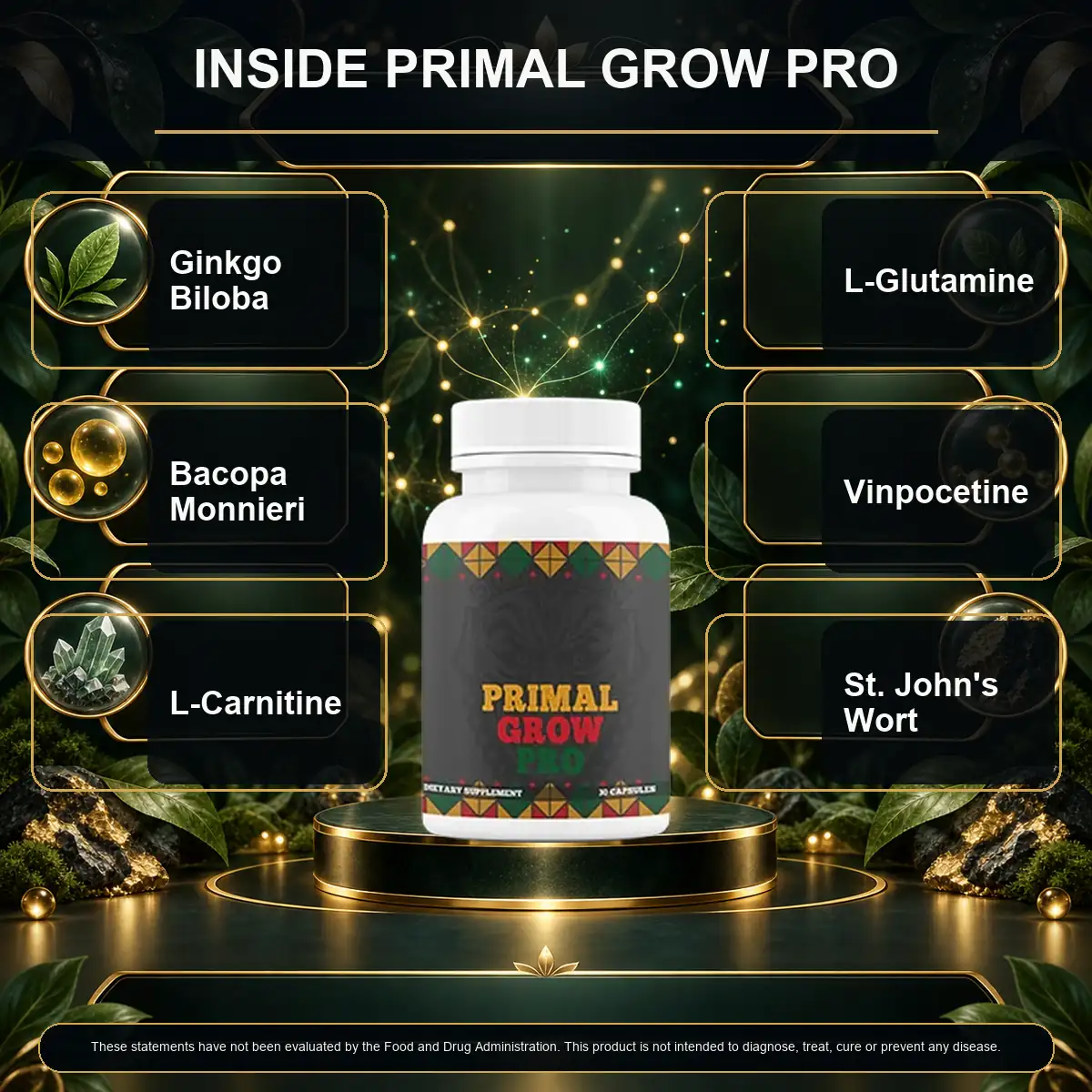
Primal Grow Pro names ginkgo first on both of its ingredient graphics and prints no quantity for it or for anything else. What that means in practice is set out on the ingredients page, which puts the 240 mg figure beside the blank rather than inventing one.
How to read a ginkgo row on any label
- Look for the amount first. 240 mg a day is the reference figure. Anything substantially under it is below what the trials used, and anything over is unusual.
- Look for the extract, not just the plant. Almost all serious ginkgo research used one standardised extract. A label naming only “ginkgo biloba” leaves open what it is standardised to, or whether it is standardised at all.
- Check whether the amount is per day or per capsule. A two-capsule serving at 120 mg each is 240 mg a day. The same 120 mg on a one-a-day product is half of it.
- Read what the product claims ginkgo is for. Cognitive claims have the better evidence base. Circulation claims were tested in legs and did not deliver.
- Be sceptical of an 84% figure. It comes from one open trial from 1998, and the two blinded replications both failed.
Ginkgo is a reasonable ingredient with a real literature, a stable reference amount and a large safety dataset behind it. That is more than most of this aisle can say. What it is not is a solved question, and the number in the title of this article is worth far more to a reader than the adjectives usually printed beside it.
References
- DeKosky ST, Williamson JD, Fitzpatrick AL, et al. Ginkgo biloba for prevention of dementia: a randomized controlled trial. JAMA. 2008;300(19):2253-62. PMID 19017911. https://pubmed.ncbi.nlm.nih.gov/19017911/
- Herrschaft H, Nacu A, Likhachev S, et al. Ginkgo biloba extract EGb 761 in dementia with neuropsychiatric features: a randomised, placebo-controlled trial to confirm the efficacy and safety of a daily dose of 240 mg. J Psychiatr Res. 2012;46(6):716-23. PMID 22459264. https://pubmed.ncbi.nlm.nih.gov/22459264/
- Hort J, Duning T, Hoerr R. Ginkgo biloba Extract EGb 761 in the Treatment of Patients with Mild Neurocognitive Impairment: A Systematic Review. Neuropsychiatr Dis Treat. 2023;19:647-660. PMID 36994422. https://pubmed.ncbi.nlm.nih.gov/36994422/
- Nicolai SP, Kruidenier LM, Bendermacher BL, et al. Ginkgo biloba for intermittent claudication. Cochrane Database Syst Rev. 2013;2013(6):CD006888. PMID 23744597. https://pubmed.ncbi.nlm.nih.gov/23744597/
- Cohen AJ, Bartlik B. Ginkgo biloba for antidepressant-induced sexual dysfunction. J Sex Marital Ther. 1998;24(2):139-43. PMID 9611693. https://pubmed.ncbi.nlm.nih.gov/9611693/
- Kang BJ, Lee SJ, Kim MD, et al. A placebo-controlled, double-blind trial of Ginkgo biloba for antidepressant-induced sexual dysfunction. Hum Psychopharmacol. 2002;17(6):279-84. PMID 12404672. https://pubmed.ncbi.nlm.nih.gov/12404672/
- Wheatley D. Triple-blind, placebo-controlled trial of Ginkgo biloba in sexual dysfunction due to antidepressant drugs. Hum Psychopharmacol. 2004;19(8):545-8. PMID 15378664. https://pubmed.ncbi.nlm.nih.gov/15378664/
- Kloft C, Hoerr R. EGb 761 Does Not Affect Blood Coagulation and Bleeding Time in Patients with Probable Alzheimer's Dementia - Secondary Analysis of a Randomized, Double-Blind Placebo-Controlled Trial. Healthcare (Basel). 2021;9(12):1670. PMID 34946404. https://pubmed.ncbi.nlm.nih.gov/34946404/