Primal Grow Pro › Blog › What The Seals Certify
What The Seals On The Bottle Page Do And Do Not Certify
Beside the bottle image for Primal Grow Pro sits a strip of round seals: Good Manufacturing Practice, Registered Facility, Genetically Modified Organism Free, Doctor Formulated, Naturally Gluten Free and a few more. They look like the visible end of a lot of checking. This article reads them the way a careful shopper would, one at a time, against what FDA, USDA and the Code of Federal Regulations actually say, and then lists the things none of them can say. It treats the seals only as artwork shown. Nothing here claims the product holds a certificate, and a picture of a seal is not a certificate.
- The GMP seal points at 21 CFR part 111, a rule that applies to every firm that manufactures, packages, labels or holds a dietary supplement. It is a legal baseline, and the rule has each firm set its own product specifications.
- FDA facility registration is a requirement, not an approval. FDA issues a registration number, not a certificate, and it does not approve or evaluate the supplement made there.
- The federal bioengineered-food rules define a narrow category and run on records the company keeps. A non-GMO seal is a claim about ingredients, and this one names no certifier.
- The gluten-free rule is specific: under 20 parts per million, and FDA’s own Q&A says it covers dietary supplements. It is also a voluntary claim, and FDA does not endorse any particular third-party program.
- “Doctor formulated” is not defined in any of the rules read for this article. On the artwork it comes with no name, no credential and no date.
- None of the seals says how much of any ingredient is in a capsule, whether it works, or whether an independent laboratory tested it. FDA says it does not approve supplements or their labeling and does not test them before sale.
The bottle, and the strip of seals beside it
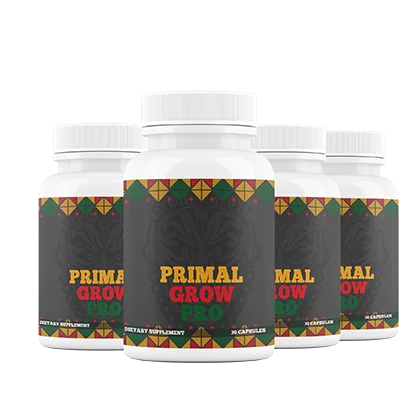
Start with what the bottle picture itself shows. The label reads “Primal Grow Pro”, “Dietary Supplement” and “30 Capsules”. It carries no seals of its own. The seals live in a separate set of artwork in the same asset pack, ten of them in all, and they are the subject of this article. They read, in the wording printed on them: Manufacture in USA, Good Manufacturing Practice, Registered Facility with FDA lettering, Genetically Modified Organism Free, Doctor Formulated, Naturally Gluten Free, and, less prominently, Dairy Free, Vegetarian, 100% Natural Ingredients and Money Back 100% Satisfaction Guaranteed.
A few ground rules for reading them fairly. They are round graphics, and a graphic can say anything. Each one makes a claim, and each claim has an ordinary meaning in regulation or in common use. For most of them that meaning is narrower than the impression the seal gives. None of the seals is a certificate, none shows a certificate number, and none of the ten names an organisation that checked anything. That is not unusual for seals in this category, and it is the reason to read them with the rulebook open.
The site’s testing and quality page goes through the whole set from a different angle. This article adds the regulatory sources for the five seals people most often ask about, and it stays on the wording of the rules.
| Seal artwork | Wording on it | What a rule or agency page says about that wording | What it does not tell you |
|---|---|---|---|
 | Good Manufacturing Practice | 21 CFR part 111 applies to anyone who manufactures, packages, labels or holds a dietary supplement. | Which body checked, when, and what the product contains. |
 | Registered Facility, FDA | Food facilities must register with FDA. FDA issues a registration number, not a certificate. | Any FDA approval or evaluation of the product or the factory. |
 | Genetically Modified Organism Free | USDA’s bioengineered food standard defines a narrow category and relies on records. | Which ingredients were checked, by whom, or by what test. |
 | Naturally Gluten Free | 21 CFR 101.91 defines the claim: under 20 parts per million. | Whether anyone tested this batch. |
 | Doctor Formulated | Not defined in the rules read here. | Who the doctor is, in what field, or what they did. |
Five seals, five short readings. The rest of the article unpacks each row, and then the things that none of them says.
“Good Manufacturing Practice”: a rule everyone has to follow
The GMP seal points at a specific regulation. 21 CFR 111.1 says you are subject to part 111 if you manufacture, package, label or hold a dietary supplement, including a supplement you make that another person packages or labels, and including imports. There is a narrow exception for holding supplements at a retail establishment solely for direct sale to consumers. FDA’s Small Entity Compliance Guide explains that the rule was published in the Federal Register on 25 June 2007, and that it is binding and has the force of law.
The consequence is easy to miss. A firm that makes dietary supplements is required to follow this rule. A seal saying “Good Manufacturing Practice” is therefore a statement that a firm is meeting the legal minimum, not a mark of distinction above it. It is a bit like a restaurant advertising that it follows food safety law.
What does the rule actually ask for? It defines “quality” in 21 CFR 111.3 as the product consistently meeting the established specifications for identity, purity, strength and composition and limits on contaminants, made and held under conditions that prevent adulteration. And 21 CFR 111.70 tells the firm to establish those specifications: an identity specification for each component, further specifications needed to make sure purity, strength and composition are met, and limits on contamination.
Notice the phrase “established specifications”. The rule makes the firm write its own. A review from the United States Pharmacopeial Convention, Sarma and colleagues in 2016, says the GMP regulations require manufacturers to establish their own quality specifications and that numerous FDA GMP inspections found those private specifications often insufficient to ensure adequate quality. The authors work for the organisation that publishes public standards, so they have a view on the remedy, but the description of how the rule is built is consistent with the rule text.
What the GMP seal cannot tell you is therefore quite a lot. It does not say which specifications the firm set or how strict they are. It does not say the amount of any ingredient. It does not say whether an outside auditor ever looked, or when. It reads “Good Manufacturing Practice”, not “certified”, and it names no certifier. FDA’s consumer Q&A page describes the regulator’s role as inspecting manufacturing establishments, among other things, and says it does not test supplements before they are sold. A reader who wants to know whether a given facility has been inspected has to ask; a seal will not answer.
“Registered Facility”: on a list, not approved
This is probably the seal most often read as more than it is, and the FDA pages are unusually direct about it. Under section 415 of the Federal Food, Drug, and Cosmetic Act, 21 CFR 1.225 says you must register a facility if you own, operate or are agent in charge of a domestic or foreign facility that manufactures, processes, packs or holds food for consumption in the United States, unless an exemption applies. FDA’s registration page lists dietary supplements among the regulated products. So, like GMP, registration is a requirement placed on firms and not an achievement.
FDA’s registration page adds what the process contains. Since the Food Safety Modernization Act, registrants must give additional information, including an assurance that FDA will be permitted to inspect the facility, and must renew every other year. FDA can suspend a registration when food from a facility has a reasonable probability of causing serious adverse health consequences or death. A promise to allow inspection is not an inspection, and a suspension power is not a routine quality check.
Then there is the bit that matters most for reading the roundel. FDA has a page for questions about registration, and the answer to the second question is unambiguous: food facilities do not need a certificate of registration, and FDA does not issue one, nor does it recognise one issued by a private business. FDA issues a registration number. The same page says there is no fee to register and that private firms offering registration services are not affiliated with FDA. And 21 CFR 1.231 says that after electronic submission FDA verifies the facility’s unique facility identifier and that the address matches, before confirming the registration number. That is a check that the facility is who it says it is, where it says it is.
So a roundel reading “Registered Facility” with FDA lettering means, at most, that a facility making or handling the product has a registration number on file. It says nothing about FDA approving the product, evaluating its contents, or having visited the factory. FDA’s own Q&A page is blunt on the underlying fact: under the law that governs supplements, FDA does not have the authority to approve them before they are marketed.
“Genetically Modified Organism Free”: a claim with no named checker
This seal is about how ingredients were grown or made, and the federal rules that touch it are about disclosure, not about the seal. The US National Bioengineered Food Disclosure Standard, run by USDA’s Agricultural Marketing Service, requires food manufacturers, importers and certain retailers to disclose foods that are or may be bioengineered. Its definition in 7 CFR 66.1 covers foods containing genetic material modified through in vitro recombinant DNA techniques, where the modification could not otherwise be obtained through conventional breeding or found in nature, and it excludes food that does not contain modified genetic material because that material is not detectable.
Section 66.9 explains what “not detectable” rests on. It can be records showing the food came from a non-bioengineered crop or source, or records showing the food went through a refining process validated to make modified genetic material undetectable, or certificates of analysis or other testing records. In other words, the federal system runs largely on paperwork the responsible company keeps, and it defines a narrow technical category.
A “GMO Free” seal on a supplement is a different animal. It is a voluntary statement. The definitions I read do not define a “non-GMO” seal, and this artwork names no certification programme, no auditor and no test. It does not say which of the seven ingredients it covers or whether it refers to the plant material, to processing aids, or to how any of the seven ingredients was produced. It leaves a reader unable to tell whether it reflects a laboratory result, a supplier’s letter, or a design choice.
“Naturally Gluten Free”: the most specific claim on the strip
Of all the seals, gluten-free has the most precise legal definition, and it is worth knowing. 21 CFR 101.91 defines the claim. A “gluten-free” food must not contain an ingredient that is a gluten-containing grain (wheat, rye or barley), or an ingredient derived from one that has not been processed to remove gluten, or one that has been processed to remove gluten if its use results in 20 parts per million or more gluten in the food, or the food must inherently not contain gluten. Any unavoidable presence must be below 20 ppm. A food that carries the claim and fails is deemed misbranded.
FDA’s Q&A page on the rule states that it applies to FDA-regulated packaged foods, including dietary supplements. It describes “gluten-free” as a voluntary claim that manufacturers may use if they meet the requirements, and says the agency will consider regulatory action for misbranded products case by case. On third-party programmes it says makers may show a certification logo if truthful and not misleading, and that FDA does not endorse, accredit or recommend any particular programme.
Two things follow. First, this is the one seal on the strip whose claim a reader can sanity-check against the label, because the ingredient list names seven items and none of them is a cereal grain. Second, checking the claim is not the same as testing the capsule. Measuring gluten near the 20 ppm threshold depends on the method used. A 2026 review of gluten analysis reports that agreement between laboratories is strongest in unprocessed materials and falls in baked, fat-rich or fermented foods, and that results differ between assay kits. Nothing on the ingredient list is a cereal grain, which is consistent with the claim, but the seal itself carries no test result and no batch.
The word “naturally” in the artwork is not something the rule defines. It suggests gluten-freedom is inherent, which for this list of names is plausible, and it leaves open how the capsule shell and any flow agents were handled, which the artwork does not mention.
“Doctor Formulated”: a phrase without a definition
The seal is a black-and-white stethoscope with two words. Of all of them it is the one where the regulatory text has least to say, and the reason is that none of the provisions reviewed for this article defines the phrase or sets a qualification for whoever it refers to. It is a marketing description.
What does apply is the general standard for claims. 21 CFR 101.93, which governs the statements a supplement may make about how an ingredient affects the structure or function of the body, requires the firm to notify FDA within 30 days of first marketing and to certify that it has substantiation that the statement is truthful and not misleading. The mandatory disclaimer must accompany such statements: “These statements have not been evaluated by the Food and Drug Administration. This product is not intended to diagnose, treat, cure, or prevent any disease.” FDA’s consumer Q&A page adds that FDA generally does not approve supplement claims or labelling before use.
So a reader has to fill in the gaps. Who is the doctor, in what specialty, and at what stage of the work? Did they choose the ingredients, set the amounts, or approve a draft? The artwork carries no name, no credential, no institution and no date. Without those, the phrase cannot be checked, cannot be compared with anything, and does not change what the label prints, which for this product is seven names and no amounts.
The rest of the strip, briefly
- Manufacture in USA. The Federal Trade Commission’s rule at 16 CFR 323.2 treats a “Made in the United States” label as an unfair or deceptive practice unless final assembly or processing happens in the United States, all significant processing does, and all or virtually all ingredients or components are made and sourced there. The seal reads “Manufacture in USA”, which is not the same words, so I have not assumed that test applies to it. The artwork does not say which steps or ingredients it means.
- Dairy Free, Vegetarian, 100% Natural Ingredients. I did not find a definition of these three in the rules read for this article, so I leave them alone rather than guess. The ingredient list does not include a milk-derived name, and the capsule shell is not identified in the artwork.
- Money-back mark. A purchase policy, not a product finding. It has its own article, A 60-Day Primal Grow Pro Return Policy Is Not A Vitality Timeline.
What none of the seals can say
The most useful way to read the strip is to list what is missing from it, because the missing items are the ones a purchase decision leans on.
They do not say how much of anything is in a capsule
FDA’s Q&A page says there are no laws or regulations that limit the serving size of a dietary supplement or the amount of a dietary ingredient in a serving, and that this decision is made by the manufacturer and does not need FDA approval. None of the seals connects to a quantity. Quantities normally appear in a Supplement Facts panel, the format set out in 21 CFR 101.36, and the bottle artwork shown here carries none. The article on reading a label with no amounts takes that up directly.
They do not say it works
Every seal is about how a product was made or what it does not contain. None is about whether it does anything. FDA’s Q&A page says FDA does not approve dietary supplements or their labelling, apart from certain categories of claim that need premarket review, and the manufacturer is responsible for making sure its product is not adulterated or misbranded.
They do not say anyone independent tested it
FDA says it does not test dietary supplements before they are sold to consumers, and that its limited analytical resources go first to emergencies and suspected violations. That leaves outside testing to be arranged by others, and none of the five seals names an organisation that did. Why does that matter? Because when independent laboratories do check labelled products, the results are not always comfortable. In a 2024 case series in JAMA Network Open, researchers bought 30 weight-loss supplements from online sellers in June 2023 and analysed them by liquid chromatography-mass spectrometry; 25 had inaccurate labels, 24 had listed ingredients that were not detected, and 7 had components not on the label. That study covered a different product category and cannot be applied to this one, but it shows what independent testing can find that a printed seal cannot.
A review from NIH’s Office of Dietary Supplements, Dwyer and colleagues in 2018, gives the wider background on the regulatory challenges in supplement research, if you would like the framework beyond this one label.
Read the label, then decide about Primal Grow Pro
The seals describe factories and ingredients. They do not describe amounts, results or independent testing. Weigh that with everything else on the page.
Order Primal Grow ProQuestions worth asking before trusting a seal
- GMP: Which firm, at which address, and has any outside body audited it? When?
- Registered facility: Under what registration number, and is that the facility that actually makes this product?
- GMO free: Which ingredients does it cover, and on what records or tests does it rest?
- Gluten free: Was this product tested against the 20 ppm limit, by whom, and does the capsule shell fall inside the claim?
- Doctor formulated: Who, in which field, and what did they decide?
- All of them: Is there an independent laboratory result for this product, and can I see it?
Those questions are not aimed at anyone in particular. They are the questions any seal invites, and a seal that can be traced to a named body, a certificate and a date is worth more than one that cannot. If the answers exist, good; if they do not, the seal is decoration, and the decision should rest on what the label and the research say. For this product that is a list of seven names, no printed amounts, and a set of ingredient articles that give each name the trial doses it was studied at.
References
- Code of Federal Regulations. 21 CFR 111.1, Who is subject to this part? (dietary supplement current good manufacturing practice). eCFR. https://www.ecfr.gov/current/title-21/section-111.1
- Code of Federal Regulations. 21 CFR 111.3, What definitions apply to this part? eCFR. https://www.ecfr.gov/current/title-21/section-111.3
- Code of Federal Regulations. 21 CFR 111.70, What specifications must you establish? eCFR. https://www.ecfr.gov/current/title-21/section-111.70
- U.S. Food and Drug Administration. Small Entity Compliance Guide: Current Good Manufacturing Practice in Manufacturing, Packaging, Labeling, or Holding Operations for Dietary Supplements. FDA guidance page. https://www.fda.gov/regulatory-information/search-fda-guidance-documents/small-entity-compliance-guide-current-good-manufacturing-practice-manufacturing-packaging-labeling
- Sarma N, Giancaspro G, Venema J. Dietary supplements quality analysis tools from the United States Pharmacopeia. Drug Test Anal. 2016;8(3-4):418-23. PMID 26857794. https://pubmed.ncbi.nlm.nih.gov/26857794/
- Code of Federal Regulations. 21 CFR 1.225, Who must register under this subpart? eCFR. https://www.ecfr.gov/current/title-21/section-1.225
- Code of Federal Regulations. 21 CFR 1.231, How and where do you register or renew your registration? eCFR. https://www.ecfr.gov/current/title-21/section-1.231
- U.S. Food and Drug Administration. Registration of Food Facilities and Other Submissions. FDA page. https://www.fda.gov/food/guidance-regulation-food-and-dietary-supplements/registration-food-facilities-and-other-submissions
- U.S. Food and Drug Administration. Questions Regarding Whether Food Facilities are Required to Pay Registration Fees and Private Businesses Claiming or Suggesting an Affiliation with FDA. FDA page. https://www.fda.gov/food/guidance-regulation-food-and-dietary-supplements/questions-regarding-whether-food-facilities-are-required-pay-registration-fees-and-private
- U.S. Food and Drug Administration. Questions and Answers on Dietary Supplements. FDA page. https://www.fda.gov/food/information-consumers-using-dietary-supplements/questions-and-answers-dietary-supplements
- USDA Agricultural Marketing Service. BE Disclosure (National Bioengineered Food Disclosure Standard). USDA page. https://www.ams.usda.gov/rules-regulations/be
- Code of Federal Regulations. 7 CFR 66.1, Definitions (bioengineered food). eCFR. https://www.ecfr.gov/current/title-7/section-66.1
- Code of Federal Regulations. 7 CFR 66.9, Detectability. eCFR. https://www.ecfr.gov/current/title-7/section-66.9
- Code of Federal Regulations. 21 CFR 101.91, Gluten-free labeling of food. eCFR. https://www.ecfr.gov/current/title-21/section-101.91
- U.S. Food and Drug Administration. Questions and Answers on the Gluten-Free Food Labeling Final Rule. FDA page. https://www.fda.gov/food/nutrition-food-labeling-and-critical-foods/questions-and-answers-gluten-free-food-labeling-final-rule
- Popping B, Bartsch D, Besler-Scharf M, et al. Gluten Analysis and Regulation: Scientific, Analytical, and Economic Dimensions of Gluten-Free Assurance. Compr Rev Food Sci Food Saf. 2026;25(4):e70516. PMID 42313578. https://pubmed.ncbi.nlm.nih.gov/42313578/
- Code of Federal Regulations. 21 CFR 101.93, Certain types of statements for dietary supplements. eCFR. https://www.ecfr.gov/current/title-21/section-101.93
- Code of Federal Regulations. 21 CFR 101.36, Nutrition labeling of dietary supplements. eCFR. https://www.ecfr.gov/current/title-21/section-101.36
- Code of Federal Regulations. 16 CFR 323.2, Prohibited acts (Made in USA labeling). eCFR. https://www.ecfr.gov/current/title-16/section-323.2
- Crawford C, Avula B, Lindsey AT, Katragunta K, Khan IA, Deuster PA. Label Accuracy of Weight Loss Dietary Supplements Marketed Online With Military Discounts. JAMA Netw Open. 2024;7(5):e249131. PMID 38691359. https://pubmed.ncbi.nlm.nih.gov/38691359/
- Dwyer JT, Coates PM, Smith MJ. Dietary Supplements: Regulatory Challenges and Research Resources. Nutrients. 2018;10(1):41. PMID 29300341. https://pubmed.ncbi.nlm.nih.gov/29300341/