Primal Grow Pro › Blog › St. John’s Wort At Trial Doses
St. John’s Wort At Trial Doses: What The Depression Trials Actually Tested
St. John’s wort is the ingredient on the Primal Grow Pro list with the largest body of human trials behind it, and the trials that anchor its reputation are all about depression. That is worth holding onto, because the bottle is not sold as a depression product. It names everyday male vitality, circulation, energy and mental sharpness. This article goes through what the depression trials actually enrolled, which extracts they used, at what daily amounts, over how many weeks, against what comparators, and how they defined success. Then it sets that beside what the label tells you, which is a name and nothing else.
- The Cochrane review of St. John’s wort for depression pooled 29 randomised, double-blind trials in 5,489 patients with major depression. In nine larger placebo-controlled trials the response rate ratio was 1.28, and in nine smaller ones 1.87, with marked heterogeneity between them.
- The trials enrolled people with a diagnosed depressive illness, usually defined by a score on a clinician-rated depression scale, and ran for 6 to 12 weeks. They used named extracts at stated daily doses, mostly in the range of 500 to 1,500 mg of extract.
- Two large US trials found no benefit over placebo in major depression, and in one of them the active comparator sertraline did not separate from placebo either. The authors of that trial suggested the test itself may have lacked sensitivity.
- A six-week trial that varied only the hyperforin content of otherwise identical extracts found that the 5% hyperforin extract beat placebo and the 0.5% extract did not. Extract identity is part of the result.
- The label prints no amount for St. John’s wort and does not name an extract, so no comparison between the capsule and any trial dose can be made.
- Vitality and energy in men who are not depressed are not outcomes any of these trials was built to measure.
What the label gives, and what it withholds
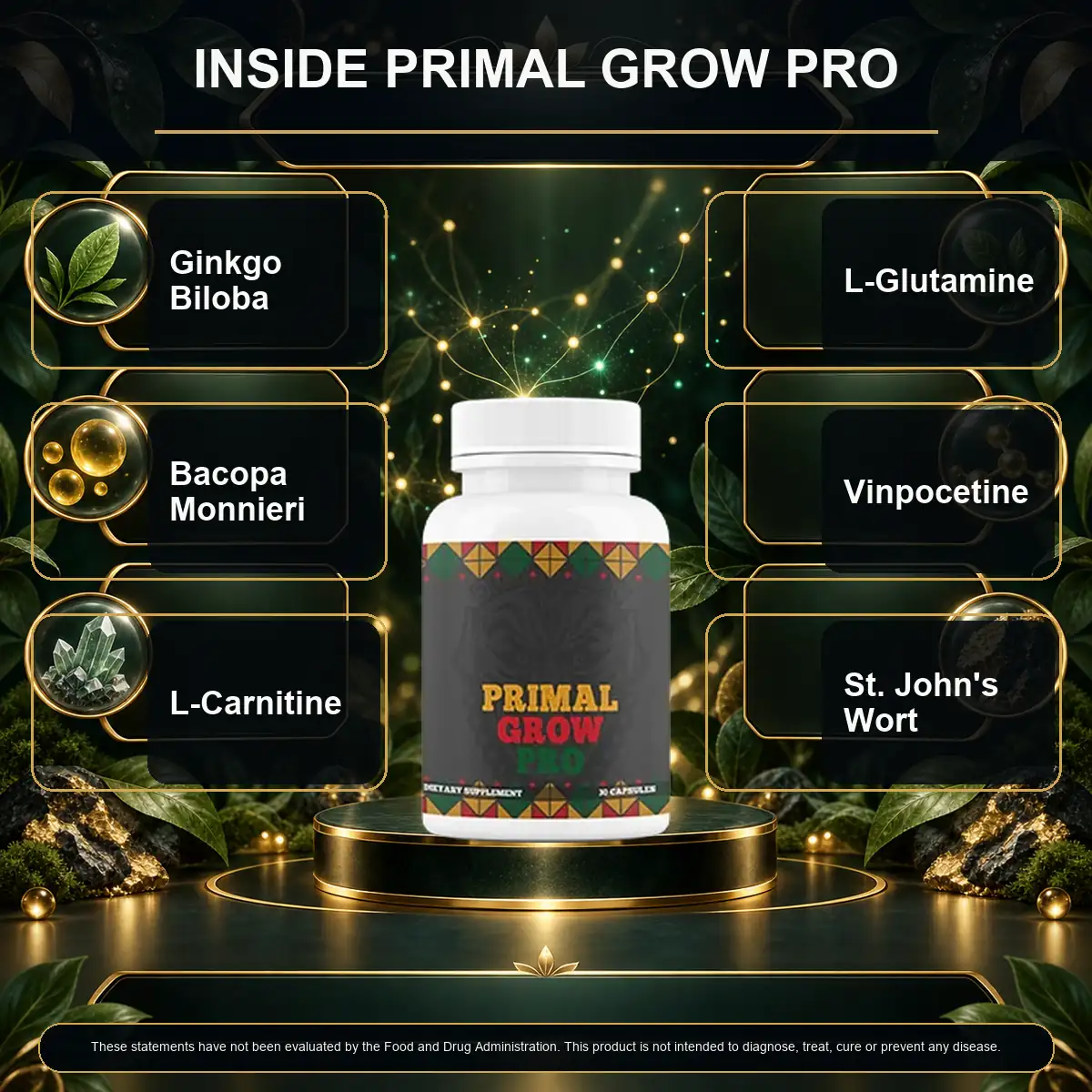
The artwork shipped with Primal Grow Pro names St. John’s wort as one of seven ingredients. It prints no amount beside it. It does not say which extract is used, whether the extract is standardised to anything, or how much of it a capsule holds. All of that is normal for the way this label is laid out, and it is the reason the rest of this article is written the way it is: a trial dose is a fact about a trial, and without a printed amount there is nothing for it to be compared with.
Two words will recur, so here they are in plain terms. An extract is a concentrated preparation of the plant, made with a particular solvent and process, and the trials below each used a specific, named one. Hyperforin and hypericin are two of the plant constituents that extracts are usually described by. Which extract, and how much of which constituent, turns out to matter.
The interactions of this herb with prescription medicines are a separate subject with their own article, St. John’s Wort And Your Prescription, and they are not repeated here. This one is only about the efficacy evidence: what was tested, in whom, and at what dose.
The Cochrane review: who was in it and what it counted
The reference point is the Cochrane review by Linde, Berner and Kriston, “St John’s wort for major depression”, published in 2008. Its inclusion rules are worth reading closely because they are the definition of what counts as evidence for this herb. A trial had to be randomised and double-blind, to enrol patients with major depression, to compare a hypericum extract with placebo or a standard antidepressant, and to include clinical outcomes that assess depressive symptoms. The main outcome was the responder rate ratio, meaning the relative chance of having a response to treatment.
Twenty-nine trials with 5,489 patients met those rules, 18 comparisons with placebo and 17 with synthetic standard antidepressants. Against placebo the results were heterogeneous. In nine larger trials the combined response rate ratio was 1.28 (95% confidence interval 1.10 to 1.49), and in nine smaller trials it was 1.87 (1.22 to 2.87). Against older tricyclic and tetracyclic antidepressants the ratio was 1.02 (0.90 to 1.15, five trials), and against SSRIs 1.00 (0.90 to 1.11, twelve trials). Patients given hypericum dropped out because of adverse effects less often than those given older antidepressants (odds ratio 0.24) or SSRIs (0.53).
The review’s conclusion was that the extracts tested in the included trials were superior to placebo in patients with major depression, similarly effective as standard antidepressants and had fewer side effects. It also said something that is easy to skip past. Trials from German-speaking countries reported findings more favourable to hypericum, and the association of country of origin and trial size with effect sizes complicated the interpretation. The authors disclosed a research grant, speaking fees or travel reimbursement from an extract manufacturer, which does not invalidate a review but is worth knowing.
A later review from RAND, Apaydin and colleagues in 2016, took a broader sweep. It included 35 studies in 6,993 patients, and found the herb associated with more responders than placebo (relative risk 1.53, 95% confidence interval 1.19 to 1.97, 18 trials, moderate quality of evidence, with high heterogeneity) and no difference in effectiveness from antidepressants in mild and moderate depression. It noted that only eight of the studies evaluated a hypericum extract combining 0.3% hypericin and 1 to 4% hyperforin, that severe depression was under-studied, and that the heterogeneity lowered its confidence in the whole.
Notice what both reviews are reviews of. They are reviews of extracts of a herb in adults diagnosed with depression, in trials of weeks to a few months. Nowhere in either abstract is a healthy adult, an energy outcome, or a once-daily capsule in a blend.
The named trials, one at a time
Every claim about “the trials” is really a claim about a particular set of studies, so here are the ones most often cited, with the details that determine what they can be used for.
| Trial | Population | Extract and daily amount | Comparator and length | Result |
|---|---|---|---|---|
| Lecrubier, 2002 | 375 adult outpatients with mild to moderate major depression (DSM-IV) | WS 5570, 300 mg three times a day | Placebo, 6 weeks | Larger fall in the 17-item Hamilton score, more responders and remissions. Effect greater with higher baseline scores. |
| Woelk, 2000 | 324 outpatients with mild to moderate depression | ZE 117, 250 mg twice a day | Imipramine 75 mg twice a day, 6 weeks | Hamilton scores fell from 22.4 to 12.0 on hypericum and from 22.1 to 12.75 on imipramine. No significant difference; adverse events 39% versus 63%. |
| Schrader, 2000 | 240 people with mild to moderate depression, entry Hamilton 16 to 24 | Ze 117 (dose not given in the abstract) | Fluoxetine, 6 weeks | End-point Hamilton 11.54 on hypericum, 12.20 on fluoxetine. Adverse events 8% versus 23%. |
| Wheatley, 1997 | Outpatients with mild to moderate depression | LI 160, 900 mg | Amitriptyline 75 mg, 6 weeks | No significant difference in response rate, a tendency favouring amitriptyline. Adverse events 37% versus 64%. |
| Szegedi, 2005 | 251 outpatients with moderate to severe major depression, Hamilton of 22 or more | WS 5570, 900 mg a day as printed in the abstract (see note) | Paroxetine 20 mg, 6 weeks | Hamilton score fell 14.4 points on hypericum and 11.4 on paroxetine. Non-inferior and statistically superior. |
| Shelton, 2001 | 200 adults with major depression, Hamilton of 20 or more | 900 mg a day, raised to 1,200 mg after 4 weeks without response | Placebo, 8 weeks | No difference on the Hamilton score or on response. Remission 14.3% versus 4.9%. Headache 41% versus 25%. |
| Hypericum Depression Trial Study Group, 2002 | 340 adults with major depression, Hamilton of 20 or more | LI-160, 900 to 1,500 mg a day | Placebo and sertraline 50 to 100 mg, 8 weeks | Neither hypericum nor sertraline differed from placebo. Full response 31.9% placebo, 23.9% hypericum, 24.8% sertraline. |
| Fava, 2005 | 135 patients with major depressive disorder | LI-160, 900 mg a day | Placebo and fluoxetine 20 mg, 12 weeks | Lower end-point score than fluoxetine; a trend against placebo (P = 0.096), in a trial 25% smaller than planned. |
Eight trials, six named extracts, seven comparators, and daily amounts of extract from 500 to 1,500 mg. A note on Szegedi: the journal later published an erratum for a dosage error in the article text, so anyone leaning on that figure should read the paper itself.
What jumps out of the table is how specific everything is. Every row has a diagnosed population, usually defined by a Hamilton depression score, an extract identified by a code, a daily amount of that extract, a duration, and a named comparator. The results are also less uniform than the Cochrane headline suggests: some of the trials are positive against placebo, some are equivalent to a drug, and two of the largest American trials are flat.
The trials that came back flat
The two US trials in the table deserve their own section, because their result is easy to lose beneath the pooled numbers.
In Shelton’s trial, 200 outpatients with major depression took a standardised extract at 900 mg a day, raised to 1,200 mg if there was no adequate response after four weeks, or placebo, for eight weeks. The rate of change in the Hamilton score did not differ between groups, and neither did the proportion who met the trial’s definition of response. Remission was reached by 14.3% on the herb and 4.9% on placebo, which is a significant difference in a very small number of people. The authors concluded that in this study the herb was not effective for major depression.
In the Hypericum Depression Trial Study Group study, 340 adults with a Hamilton score of at least 20 took the extract LI-160, dosed between 900 and 1,500 mg a day according to response, or sertraline, or placebo, for eight weeks. On both primary measures neither treatment differed from placebo. The change in Hamilton score was 9.20 points on placebo, 8.68 on the herb and 10.53 on sertraline. The authors wrote that the result may be due to low assay sensitivity, since a trial in which a standard antidepressant also fails to separate from placebo cannot tell you much about the herb, but that the complete absence of trends suggestive of efficacy for the herb was noteworthy. A later reanalysis of its data asked what patients believed they were receiving. Assigned treatment had no significant effect on improvement in that analysis, while the patient’s own guess was significantly associated with it, which is a useful reminder of how large expectation can be in this field.
Then there is Fava’s trial, where the herb finished with a better mean score than fluoxetine and only a trend against placebo. The authors said a sample 25% smaller than planned probably accounts for the lack of significance. Read literally, a trial that misses its sample size and lands on a P value of 0.096 does not prove anything, and it does not disprove it either.
None of this says the herb does not work in depression. The Cochrane and RAND reviews say that on balance it appears to, in mild to moderate cases and with the extracts tested. It says the evidence is uneven, that the stronger results cluster in specific extracts and in specific trial settings, and that the sceptical trials were run to a high standard.
Extract identity is part of the result
The easiest mistake to make with a trial number is to treat it as a property of the plant. It is a property of an extract. A 1998 randomised trial by Laakmann and colleagues tested exactly that in 147 outpatients with mild or moderate depression. The two extracts, WS 5572 and WS 5573, were made by the identical manufacturing process and differed only in hyperforin content: 5% for WS 5572 and 0.5% for WS 5573. Each was given as one 300 mg tablet three times a day for 42 days, against placebo.
The Hamilton score fell by 10.3 points on the 5% hyperforin extract, 8.5 on the 0.5% extract and 7.9 on placebo, with a significant trend across the three. In pairwise comparison only the 5% extract was superior to placebo, and the clinical effects of the 0.5% extract were described as comparable to placebo. The authors concluded that the therapeutic effect depends on hyperforin content.
Two lessons come out of that single study. First, two products both honestly labelled “St. John’s wort extract, 300 mg” can behave differently from each other in a trial. Second, the Apaydin review’s remark that only eight studies used a hypericin-and-hyperforin extract of one specific composition makes more sense: the pooled literature is a family of related but different products. A label that names the herb and stops there cannot say which member of the family it resembles.
What “response” meant in these trials
The outcome in nearly every trial above is a clinician-rated depression scale, most often the Hamilton Depression Rating Scale in its 17- or 21-item form, sometimes with the Montgomery-Asberg scale and a global impression rating alongside. A trial then converts scores into categories. In Lecrubier’s study a responder was someone with at least a 50% fall in the 17-item Hamilton total, and remission was a total of 6 or lower at the end. In Fava’s study remission meant a score below 8. In the Hypericum Depression Trial, full response was defined from the Hamilton and global impression scores together.
These are measures of a diagnosed illness in people who scored high enough at the start to be enrolled. A fall from 22 to 12, as in Woelk’s trial, is a fall in a symptom score from a clinical level of depression to a lower one. Nothing about it says how energetic, vital or sharp someone felt, and nothing about it applies to a person who began with no depressive illness and had no score to fall from.
There is a second, quieter point in the way the doses are reported. Several of the trials adjusted the dose upward in people who had not responded, or set a range. A range is a design decision about a clinical population. It is not a recommendation to anyone else.
What a vitality claim is not
Put the pieces side by side. The seller names four supports: everyday male vitality, circulation, energy and mental sharpness. The trials above tested a different thing: whether an extract lowers a depression score in a person with a diagnosed depressive illness over weeks. The two overlap in a loose everyday sense, since low mood and low energy often travel together, and they do not overlap in any way that lets one stand in for the other.
- The population is different. The trials enrolled people diagnosed with depression. A man reading a label for vitality is, in the trial sense, an untested population.
- The outcome is different. The trials measured depression scales. None of the abstracts above reports a vitality or energy endpoint.
- The product is different. The trials used named extracts at stated doses. The label names none and prints no dose.
- The setting is different. The trials gave one active ingredient, or one against another. A capsule with seven names has six other things in it, and the trials say nothing about how the seven behave together.
The same shape of argument appears in the article on what the ginkgo number was for, and it is the ordinary way to read any ingredient with a large literature: ask what the literature was a test of.
Persistent low mood, loss of interest, or a change in energy that lasts weeks is a reason to see a clinician, and the trials above are a reason to say so rather than a reason to try a capsule. Depression is a treatable medical condition, the herb in the trials was studied in that setting, and it interacts with a long list of prescription medicines, which the separate article covers. A supplement with an unstated amount of an unstated extract is not the same thing as the product that was tested.
Read the label first, then decide about Primal Grow Pro
Seven ingredients, no printed amounts, and one of them is a herb whose research is entirely about depression. Weigh that before you order.
Order Primal Grow ProHow to read a St. John’s wort row on any label
- Look for the extract. A code such as WS 5570 or LI 160, or a stated hypericin and hyperforin content, is the first sign the row can be compared with anything. The plant name alone does not qualify.
- Look for the daily amount and how it is divided. The trials gave 500 to 1,500 mg a day, usually split into two or three doses. A single figure with no extract behind it is much harder to interpret.
- Ask what the claim on the front is. If it is mood, the evidence is depression trials. If it is anything else, the evidence has to be found separately, and here I found none among the trials above.
- Remember the medicine question. The herb changes how the body handles other drugs. That is not an efficacy point, and it is the reason to talk to a pharmacist.
- Be careful with the pooled headline. “Superior to placebo” summarises heterogeneous trials and comes with a warning from its own authors about where the studies came from.
None of this makes St. John’s wort a bad ingredient. It has one of the largest human research bases in the aisle, and the research is about something specific. The label under discussion names the herb and leaves out everything that would let a reader connect it to that research, which is a different statement from saying the herb does not work.
References
- Linde K, Berner MM, Kriston L. St John’s wort for major depression. Cochrane Database Syst Rev. 2008;2008(4):CD000448. PMID 18843608. https://pubmed.ncbi.nlm.nih.gov/18843608/
- Apaydin EA, Maher AR, Shanman R, et al. A systematic review of St. John’s wort for major depressive disorder. Syst Rev. 2016;5(1):148. PMID 27589952. https://pubmed.ncbi.nlm.nih.gov/27589952/
- Lecrubier Y, Clerc G, Didi R, Kieser M. Efficacy of St. John’s wort extract WS 5570 in major depression: a double-blind, placebo-controlled trial. Am J Psychiatry. 2002;159(8):1361-6. PMID 12153829. https://pubmed.ncbi.nlm.nih.gov/12153829/
- Woelk H. Comparison of St John’s wort and imipramine for treating depression: randomised controlled trial. BMJ. 2000;321(7260):536-9. PMID 10968813. https://pubmed.ncbi.nlm.nih.gov/10968813/
- Schrader E. Equivalence of St John’s wort extract (Ze 117) and fluoxetine: a randomized, controlled study in mild-moderate depression. Int Clin Psychopharmacol. 2000;15(2):61-8. PMID 10759336. https://pubmed.ncbi.nlm.nih.gov/10759336/
- Wheatley D. LI 160, an extract of St. John’s wort, versus amitriptyline in mildly to moderately depressed outpatients--a controlled 6-week clinical trial. Pharmacopsychiatry. 1997;30 Suppl 2:77-80. PMID 9342764. https://pubmed.ncbi.nlm.nih.gov/9342764/
- Szegedi A, Kohnen R, Dienel A, Kieser M. Acute treatment of moderate to severe depression with hypericum extract WS 5570 (St John’s wort): randomised controlled double blind non-inferiority trial versus paroxetine. BMJ. 2005;330(7490):503. (An erratum for a dosage error in the article text was published in BMJ 2005;330(7494):759.) PMID 15708844. https://pubmed.ncbi.nlm.nih.gov/15708844/
- Shelton RC, Keller MB, Gelenberg A, et al. Effectiveness of St John’s wort in major depression: a randomized controlled trial. JAMA. 2001;285(15):1978-86. PMID 11308434. https://pubmed.ncbi.nlm.nih.gov/11308434/
- Hypericum Depression Trial Study Group; Davidson JR, Gadde KM, Fairbank JA, et al. Effect of Hypericum perforatum (St John’s wort) in major depressive disorder: a randomized controlled trial. JAMA. 2002;287(14):1807-14. PMID 11939866. https://pubmed.ncbi.nlm.nih.gov/11939866/
- Fava M, Alpert J, Nierenberg AA, et al. A double-blind, randomized trial of St John’s wort, fluoxetine, and placebo in major depressive disorder. J Clin Psychopharmacol. 2005;25(5):441-7. PMID 16160619. https://pubmed.ncbi.nlm.nih.gov/16160619/
- Laakmann G, Schüle C, Baghai T, Kieser M. St. John’s wort in mild to moderate depression: the relevance of hyperforin for the clinical efficacy. Pharmacopsychiatry. 1998;31 Suppl 1:54-9. PMID 9684948. https://pubmed.ncbi.nlm.nih.gov/9684948/
- Chen JA, Papakostas GI, Youn SJ, et al. Association between patient beliefs regarding assigned treatment and clinical response: reanalysis of data from the Hypericum Depression Trial Study Group. J Clin Psychiatry. 2011;72(12):1669-76. PMID 22053942. https://pubmed.ncbi.nlm.nih.gov/22053942/